
Traditional Violin Methods and the Suzuki Method: Differences, Myths, and Applications for Adults and Advanced Students
Updated: Feb 8

Few topics in violin pedagogy generate as much discussion—and misunderstanding—as the comparison between traditional violin methods and the Suzuki Method. These approaches are often presented as opposites: one analytical and notation-based, the other intuitive and ear-based. In reality, both rest on solid pedagogical foundations, and when understood correctly, the Suzuki Method can be not only appropriate but highly effective for adults and even advanced students.
This article explores the real differences between these approaches and clarifies how Suzuki principles can—and should—be applied beyond early childhood instruction.
What Are “Traditional” Violin Methods?
Traditional violin pedagogy, particularly within Western classical training, is typically characterized by:
Early emphasis on music reading
Use of technical exercises and etudes (Ševčík, Wohlfahrt, Kayser, Kreutzer, etc.)
Analytical explanations of technique
Progression based on written repertoire
Strong focus on conscious problem-solving
Teacher-centered instruction
These methods are highly effective and have produced generations of professional violinists. They excel at developing technical clarity, structural understanding, stylistic awareness, and independence in score-based learning.
However, traditional approaches may sometimes underemphasize listening skills, imitation, and the role of repetition in deep motor learning—especially in the earliest stages of skill acquisition.
What Defines the Suzuki Method?
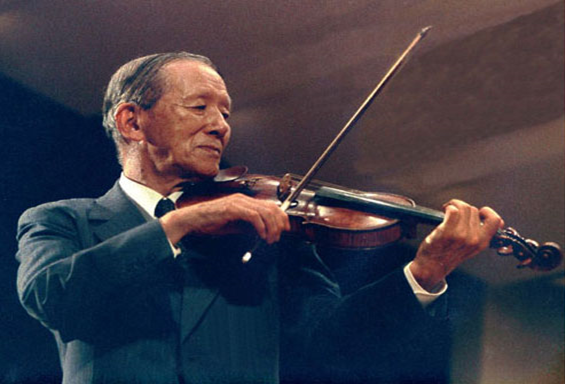
The Suzuki Method, developed by Shinichi Suzuki, is based on the idea that musical ability is learned in the same way as language: through immersion, repetition, listening, and imitation within a supportive environment.
Core principles include:
Learning first by listening and imitation, before focusing heavily on notation
Early-age learning, taking advantage of heightened neuroplasticity, while remaining adaptable to all ages
Delayed but thoughtful introduction of music reading, once physical coordination is more stable
Constant review of previously learned pieces to reinforce technique and musical memory
Strong emphasis on posture, balance, and physical ease from the very beginning
Positive reinforcement, encouragement, and confidence-building as central pedagogical tools
A nurturing, positive learning environment, often using games and playful exercises to teach complex skills
The teacher as a musical and technical model, not only an explainer
The Role of Recordings in Suzuki Learning
Recordings play a central role in Suzuki pedagogy—not merely as references for learning pieces, but as a comprehensive musical model. Through consistent listening, students absorb:
Sound quality and tone production
Articulation and bow distribution
Rhythm, pulse, and timing
Style, phrasing, and musical character
In this way, recordings function as an ongoing musical environment, shaping the student’s internal auditory model long before conscious analysis is required.
At its core, Suzuki pedagogy is not a repertoire list—it is a learning philosophy grounded in how humans acquire complex motor and artistic skills.
Common Myths About the Suzuki Method
Myth 1: Suzuki Is Only for Children
While Suzuki education is often associated with young beginners, this association is cultural rather than pedagogical. The principles of listening, repetition, imitation, and positive reinforcement are not age-dependent.
Adults may process information differently, but their nervous systems still benefit profoundly from:
Repeated exposure
Aural modeling
Incremental skill building
Learning in a supportive, low-threat environment
When adapted intelligently, Suzuki principles can be remarkably effective for adult beginners.
Myth 2: Suzuki Students Cannot Read Music Well
Music reading is not excluded in Suzuki training—it is sequenced according to how humans naturally learn. In the Suzuki Method, musical learning intentionally mirrors language acquisition: children learn to speak fluently long before they learn to read.
In the same way, students first develop:
Physical coordination
Aural awareness
Musical fluency
Only then is reading introduced as a complementary skill rather than a simultaneous burden.
By separating the physical challenge of playing from the cognitive load of decoding notation, Suzuki students often develop stronger technical security first. When reading is introduced thoughtfully, they frequently become excellent readers—precisely because technical demands no longer overwhelm cognitive resources.
Myth 3: Suzuki Lacks Technical Rigor
On the contrary, Suzuki’s insistence on posture, sound quality, intonation, and precision from the earliest stages creates a strong technical foundation—when taught with rigor and clear standards. The method’s apparent simplicity often masks its technical depth.
Suzuki Principles and Modern Learning Science
Many Suzuki principles align closely with contemporary research in neuroscience and motor learning:
Listening strengthens auditory–motor mapping
Imitation accelerates skill acquisition
Repetition consolidates neural pathways
Positive reinforcement enhances motivation and retention
Systematic review supports long-term learning
These mechanisms remain fully active in adults and advanced players.
Applying Suzuki Principles to Adult Beginners
For adult beginners, Suzuki-based teaching can be transformative when adapted appropriately.
Effective strategies include:
Extensive listening before and during repertoire study
Demonstration by the teacher as a primary learning tool
Learning short pieces by ear alongside reading
Emphasis on tone production and physical ease rather than early complexity
Reducing performance anxiety through a positive, encouraging environment
Many adults progress faster when they are freed from the pressure to intellectually control every aspect of playing from the outset.
Applying Suzuki Principles to Advanced Students
Perhaps the most overlooked application of Suzuki pedagogy is with advanced violinists.
Advanced students can benefit from:
Learning repertoire passages by ear to refine intonation and phrasing
Using imitation to internalize style, articulation, and sound concepts
Systematic review of earlier repertoire to rebalance technique
Returning to simple pieces to rebuild coordination, resonance, and ease
At higher levels, Suzuki principles function as tools for reorganization and refinement—not simplification.
Integration Rather Than Opposition
The most effective modern violin pedagogy does not force a choice between traditional and Suzuki methods. Instead, it integrates the strengths of both.
A balanced approach might include:
Technical etudes taught with strong aural modeling
Reading skills supported by listening and imitation
Analytical explanations reinforced through physical experience
Structured repetition combined with conscious problem-solving
This synthesis respects both the intellect and the nervous system.
Final Thoughts
The Suzuki Method is not a method to outgrow—it is a set of principles that remain relevant at every stage of violin development.
At its core, Suzuki pedagogy represents a deep understanding of how humans learn: through listening, imitation, repetition, encouragement, and meaningful engagement within a positive environment.
When applied flexibly and intelligently, Suzuki principles support adults, professionals, and advanced students just as powerfully as children. Far from being a limitation, the method offers a pathway to deeper musical understanding, greater technical efficiency, and a more natural, embodied relationship with the instrument.
Ultimately, the question is not whether Suzuki or traditional methods are better, but how well their principles are understood, respected, and integrated.
Comments